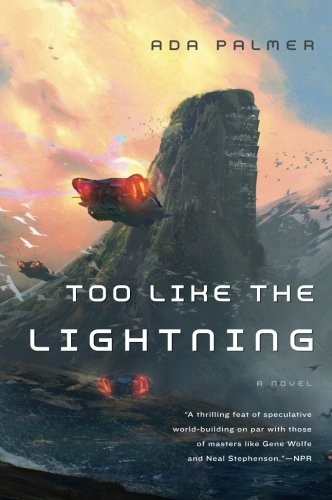
This one asks a lot of you before it gives anything back, an eighteenth century prose style grafted onto a twenty fifth century setting, a narrator who’s a convicted criminal working off his sentence as a kind of universal servant, and a plot that spends its first hundred pages establishing world building rules about gender and religion and political geography before you’re totally sure what the actual story is. I almost bounced off it in the first fifty pages the way I’ve seen other readers describe, then somewhere around the introduction of Bridger the whole thing clicked into a different gear.
The world Palmer built genuinely rewards the density. Political affiliation replacing geography, nations you choose instead of inherit, a taboo so strong around gendered pronouns that using one is treated like an obscenity, all of it is doing real philosophical work instead of just being texture, and I could tell from how consistently it holds together that she’d thought about the mechanics of it far past what makes it onto the page. It pays homage to actual Enlightenment philosophy while doing something genuinely new with it, which is a much harder needle to thread than most books that try it.
And then it just stops. Not on a cliffhanger exactly, more like someone reached over and closed the book mid conversation, because this is genuinely one story split across two volumes rather than a complete book with a sequel. I was annoyed enough that I went and bought the second one within the hour, so take that complaint with the appropriate grain of salt. Four stars, with the caveat that you should have volume two on hand before you start.