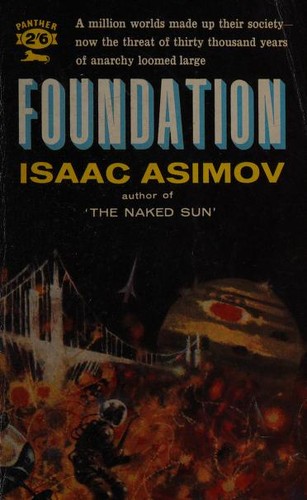
This is my first reread since I was a teenager and the thing that struck me hardest the second time around is how little of it is actually about space. Psychohistory, the idea that you can predict the future of a civilization mathematically the way you’d predict gas particle behavior, is the hook, but almost the entire book is people in rooms talking their way through political crises. Asimov tells the story of an empire’s decline over a thousand years using maybe a dozen named characters total, which is a strange kind of narrative efficiency I didn’t appreciate as a kid.
The structure is basically a set of connected vignettes, each one a crisis point where the Foundation’s survival hinges on one person figuring out the non-obvious answer, and I can see why some readers find that repetitive by the third or fourth iteration. But I found myself more interested this time in the religion-as-technological-control angle, the way the Foundation exports a fake priesthood to neighboring planets specifically to keep them dependent and non-threatening, than I was as a teenager reading it purely for the space opera scale. It reads less like science fiction now and more like a case study in soft power dressed up in a starfield.
The prose is plain, occasionally to a fault, characters explain their plans to each other in dialogue more than the scene ever shows you anything happening. But the ideas still hold up better than the sentence-level writing does. Four stars on a reread, and I finally understand why everyone kept telling me to read Gibbon’s Decline and Fall alongside it.